


Protecting the Danube's Mayflies: A Night of Conservation & Connection in Szentendre
by Zoltán Fehér, WWF Hungary

Nestled on the banks of a Danube side branch just north of Budapest, Hungary, the historic town of Szentendre is known for its vibrant cultural life and picturesque riverside setting. Last month, on the 13th August, it became the stage for one of the Danube's most spectacular natural events - the annual emergence and mating flight of millions of mayflies from the river.
While visually and emotionally striking as a natural spectacle, this remarkable phenomenon tells a much larger story about river health, biodiversity conservation and the role local communities can play in protecting Europe's largest river. The story of the mayfly is also a story about the relationship between people and nature, the challenges facing the Danube, and the power of local communities to take action for living rivers.
Bringing people closer to the river
Photos copyright © Zoltan Feher
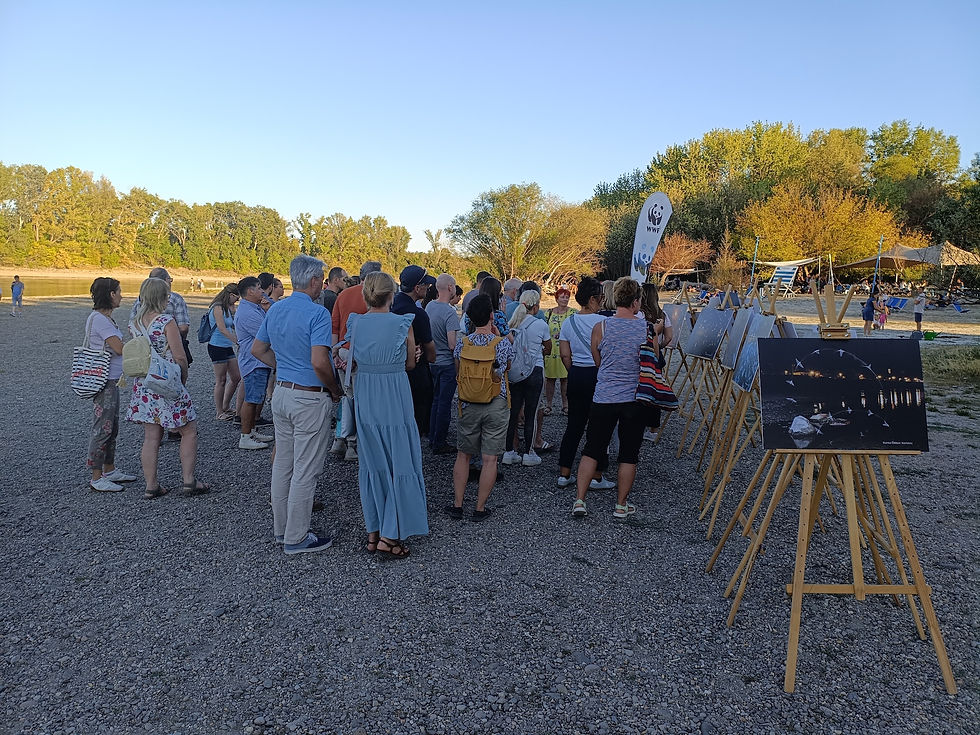
To turn this natural phenomenon into an opportunity for learning and action, the Dunavirág Fesztiválka (Little Mayfly Festival) brought together researchers, conservationists, local organisations and residents on the banks of the Danube. Organised by the Municipality of Szentendre together with the local Ökoparty film club, a local green NGO Zöldendre, the watersport club of Szigetmonostor (SZIV SE), the HUN-REN Institute of Aquatic Ecology and WWF Hungary, the festival combined hands-on conservation, environmental education and dialogue about the future of the river.
Practical conservation in action
Photos copyright © Imre Potyo
The reproductive cycle of Danube mayflies is highly sensitive. Females lay their eggs on the water surface, where the next generation begins its life cycle. Artificial lights along the riverbank, however, can disrupt this process. Instead of returning to the river, the insects may be drawn towards illuminated buildings, roads or floodlights, where they lay their eggs on unsuitable surfaces. In such cases, both the eggs and the future generation are lost.
For years, Szentendre has taken active steps to reduce this problem. During the mayfly swarming period, the city requests reduced decorative lighting along the Danube promenade, creating darker riverfront conditions that help the insects complete their life cycle successfully.
This year, however, WWF Hungary also tested an innovative new solution.
Several floodlights near the popular Kacsakő Bistro remain in operation for safety reasons and therefore cannot simply be switched off. In previous years, these lights attracted large numbers of mayflies away from the river. With support from WWF Hungary's DANUBE4all project and in cooperation with the Zöldendre Association, red light-filter foils were installed on these lamps before this year's emergence.
The initiative also served as a field experiment. Different shades and types of red filters were tested in real-world conditions, while a small number of lamps were intentionally left unchanged as controls. The aim was to identify a practical solution that would reduce the attraction of artificial lighting without compromising public safety.
The initial results were highly encouraging. The red-filtered floodlights appeared to attract significantly fewer mayflies than untreated lamps, offering a promising and easily replicable solution that could potentially be adopted by other riverside communities along the Danube.
This local experiment demonstrated that effective river conservation does not always begin with large infrastructure projects. Often, meaningful progress can be achieved through cooperation between municipalities, researchers, businesses, civil society organisations and local residents working together to solve a specific environmental challenge.
Talking about the future of the Danube
The festival programme also showcased much more than mayflies. One of the most popular elements was a mayfly rescue boat tour, which attracted more than a hundred visitors to the riverbank. From the water, participants were able to observe the swarming insects at close range while learning why such rescue efforts are sometimes necessary.
Photos copyright © Gabriella Moholanyi and Eszter Linder
The spectacular emergence and the rescue boat tours provided a powerful way to attract people to the event and created an opportunity for learning and discussion. Visitors were invited to participate in a number of educational and outreach activities focused on the future of the Danube and the pressures it faces.
One of these programmes featured a presentation and public discussion led by Szilvia Ádám, Freshwater Expert, and Zoltán Fehér, Conservation Director of WWF Hungary. Taking the current state of the Danube as a starting point, they explored some of the most pressing challenges facing the river today before inviting participants to join an open conversation.
The topic was particularly timely, as the Danube is currently experiencing historically low water levels. In recent weeks, public debate has intensified around how to respond to increasingly frequent drought periods, declining river flows and the consequences these trends may have for sectors that depend on the river, including energy production.
The presentation also addressed recurring proposals for river regulation and dam construction that tend to resurface during periods of low water. Participants had the opportunity to ask questions, share their own experiences and discuss directly with the speakers the complex challenges facing the Danube in a changing climate.
The event showed that decisions about rivers are not merely technical or engineering questions. They are also societal questions that require informed public participation. Creating opportunities for dialogue and increasing public understanding are essential steps towards developing sustainable solutions for the future of the river.
DANUBE4All in action
In this sense, the festival reflected several core objectives of the DANUBE4all project. It brought together science, conservation, freshwater practitioners, businesses, and local communities. It connected people with the river through direct experience, demonstrated the powerful impact of local collaboration, and encouraged collective reflection on how rivers can be protected and restored in the face of growing environmental pressures.
The Danube mayfly itself is a powerful symbol of this message. Its presence indicates that the river still supports ecological processes and biodiversity that have disappeared from many European waterways. At the same time, it reminds us how fragile these values remain and how dependent they are on responsible human actions.
We are all part of and related to the broader conversation on the future of the Danube. This beautiful August evening gathering was an active, meaningful, and practical showcase of what shared effort to support a healthier and more resilient river of shared benefit to all can look like.
Photos copyright © Zoltan Feher


