Two Lengths of the Danube
- Dec 17, 2025
- 8 min read
Updated: Dec 19, 2025
by Jasper Winn

In the summer of 1985, writer Jasper Winn kayaked the length of the Danube - an intrepid journey with many a twist and turn. In 2025, Jasper returned to travel the great river's length once again, this time via pedal, bus, train, and on foot. For our annual edition, he writes a special reflection on his journeys, with insights into the main changes along the river over the intervening forty years.
The summer of 1985 was a good time to kayak the Danube from Germany’s Black Forest to the Black Sea. Mikhail Gorbachev, Soviet Russia’s new leader, had introduced glasnost (transparency) and I hoped that this might make for easier travel in Europe’s East Bloc. Two thirds of the 2,850 kilometres of the river’s full length lay behind the then Iron Curtain.

Photos © Jasper Winn
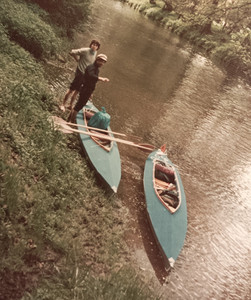
The two friends paddling with me hadn’t kayaked before. Our craft were a pair of cheap, heavy East German double folding Pouchs bought near our start in Donaueschingen. Rather than going on an expedition were setting off on a slow adventure to satisfy a curiosity about peoples and countries new to us. We would be following a river highway that had carried ideas, trade, cultures, armies and travellers across the breadth of Europe for many millennia.
The Europe of 1985 was a different socially, politically and climatically. Leaving in May we paddled and drifted east across pre-unification Germany and through Austria. At Bratislava, with its naval patrol boats, armed border guards and a reluctance to issue us visas, we went behind the Iron Curtain. After Czechoslovakia we kayaked on to Budapest and then crossed the Great Plains of Hungary to enter Yugoslavia. We spent a week in Belgrade with new friends before heading into the Cazan gorge with two huge dams of the Iron Gates system. From there I continued alone along the border between Bulgaria and Romania. Mistrust was high and I was arrested almost daily, often held at gunpoint, suspected of being a – very inept – spy. The water’s were busy with coaster-sized ships and rafts of barges speeding along, and in my tiny kayak I often felt as if I was roller-skating down a four lane motorway between massive trucks. I had been looking forward to finishing at the Black Sea after paddling through the delta but the Romanian state demanded that I change twenty dollars into worthless leu for each day I was in the country. Short of money I was forced to take a short cut down the Cernavodǎ canal, finishing on the coast at Constanța in late August. After four months of paddling to miss out on the delta, one of Europe’s greatest wildernesses, left me feeling that the trip hadn’t been fully finished.


Photos © Jasper Winn
Reading my journals from that time show the many differences between the Europe of forty years ago and today. Visas were required for every country after Austria; for Czechoslovakia we were given a twenty-four hours transit paper during which time we had to paddle over a hundred kilometres to the first official border crossing into Hungary. Each new country meant a new currency, and often risky black market deals to get better rates. Weather forecasting was a case of looking up into the sky; across the summer there were days of rain, weeks of temperatures in the high 30s, sudden, violent thunder storms and fierce winds that kicked up dangerously large waves in the approach to the Cazan gorge. Communications with home were letters sent, and the odd reply received at post restates in post offices in the bigger cities. Our maps and charts were large scale and inaccurate paper pages torn from books.



Photos © Jasper Winn
The pollution issue on people’s minds at that time was acid rain and its effect on Europe’s forests. We worried about the water quality of the river; the heavy industry waste, sewage outflows, farming run-off, and chemical spills of seven countries were left to the sheer volume of the river’s waters to dilute. In a few places we were warned specifically against swimming but mostly locals seemed to swim anywhere the waters were a healthy if murky brown, and so did we. Fishermen were catching less fish than their father’s did, we were told. There were still massive catfish up to two hundred kilos in the depths but there were far fewer of all six species of sturgeon. Dams and particularly the massive double lock system of the Iron Gates, completed in the early seventies, had changed the flow of the river in critical ways as well as blocking waters upstream for migrating fish.
Having been brought up in the ‘West Bloc’ to think of the populations behind the Iron Curtain as downtrodden folk without even basic freedoms we met, of course, people just like us in many ways. The differences seemed far more cultural than political. Every nation we paddled through, and often regions within countries, had their own languages and dialects and rituals. We also met local climbers, proper kayakers, hikers and adventurers who had travelled through the vastness of Russia, to China or into Central Asia. Many people took holidays from a wide choice of neighbouring East Bloc lands; Western Europe didn’t seem quite so big by comparison. The military and police were mistrustful of three Westerners larking about on the river, but the actual people of every country were welcoming, generous and usually keen to party. We had guitars and harmonicas, they invariably had some form of home distilled spirits, whether schnapps, pálinka, slivovitz,or tuicâ.
Paddling the length of the Danube had been an adventure, but far more it had been an experience. I felt differently about Europe at journey’s end and because of this I was different myself.
In May of 2025, forty years after paddling the length of the Danube, I made another trip down the river, again from source to sea. Instead of kayaking (nobody needs to do that twice!) I went freestyle. Over a month I walked, rode local buses and slow trains, cycled across Austria on a €40 second-hand bike, hitch-hiked and car-shared and finally headed into the delta on a series of boats.




Photos © Jasper Winn
I was curious to see what changes four decades had brought to the Danube and the countries it ran through. The Berlin Wall had fallen. Czechoslovakia had split into two and Bratislava had become a fourth capital city on the Danube’s banks. The Socialist Yugoslavian Federation had fragmented – violently – along ethnic and religious fault lines; Croatia and Serbia were now countries in their own right. Ukraine, which had become the delta’s northern border, was a war zone. All of the countries I had paddled through were either members of the EU or in accession talks. I didn’t need visas. There were still a number of distinct currencies – dinar, leu, forints - but euros were often taken unofficially or were easy to change officially. I had feared that the distinct culture and feel of each country might have been diluted and homogenised by the many kinds of unification and the freedom to travel and work abroad. But new liberties often seemed to have led to greater feelings of nationality – both positively and negatively – as well as pride in language and a preservation of traditions. There was still a lot of music being played. And nearly as much strong drink at parties.
My experience as a traveller was changed, mainly because of the internet. I had email and mobile calls to talk to people instantly. I booked trains, buses and lift shares by phone. By some clever googling I managed to reconnect with four people, in four different countries, whom I’d last been in touch when kayaking. I could see what the weather forecasts for days to come, though climate change was a tangible thing, with sudden shifts and changes and unseasonal and plain ‘wrong’ weather for May. Cold snaps, sleet, sudden hot days, back to cold rain and strong winds; none of it pleasant for my many nights sleeping out without a tent. The previous summer friends had been reporting central European temperatures over 40C for weeks on end.



Photos © Jasper Winn
And the Danube River? There were changes, of course, and mostly for the better. Water quality according to many of the sites I checked had mostly improved, with industrial waste and sewage disposal cleaned up and regulated since the end of the 20th century. My cycle along the Danube’s towpath across Austria was one of Europe’s most popular traffic-free cycle ways. As importantly it was a three hundred kilometres long refuge for wildlife; I heard tens of nightingales singing in the woods, and saw golden orioles, hares dancing in wildflower meadows, several beavers, a goshawk and much more. I had moments of deja vu; camping out on a sandy shore, after crossing the bridge from Slovakia into Hungary, I was in the exact same spot that, I realised from reading my diaries, I’d slept on four decades earlier. The rafts of black barges gliding out of a luminous mist between steep hills downstream from Regensberg seemed timeless. I revisited remote villages and cafes and bars where seemingly little – except for the prices - had changed since I’d sat in them in them forty years before.





Photos © Jasper Winn
To reach and travel through the delta was maybe the overriding motivation for following the river along its length for a second time. I was lucky to be put in touch with Viktor, a guide and boatman from a village of Old Believers, Russian Lipovans, who had fled religious persecution centuries before to find sanctuary deep in the delta. In a high speed boat Viktor took me on a day’s exploration of the lagoons, channels and the coast. He was an informed naturalist, a good historian and was interested in and knowledgeable about everything from water quality to the breeding habits of the delta’s two species of pelican. We veered up to within a kilometre of the Ukrainian border so he could explain the complexities of living on the edge of a war zone; later we went out to sea to circle a Turkish ship that had apparently been sunk by Russian drones in an attempt to block the main navigation channel. We landed in a small island village where voters were trailing in to the local school to vote in the critical national elections. We passed down tiny channels to find remote shacks where fishermen were living out their years in the wilderness and watery world that they’d have known as young men at the time I was kayaking down the Danube as a young man myself.
Photos © Jasper Winn
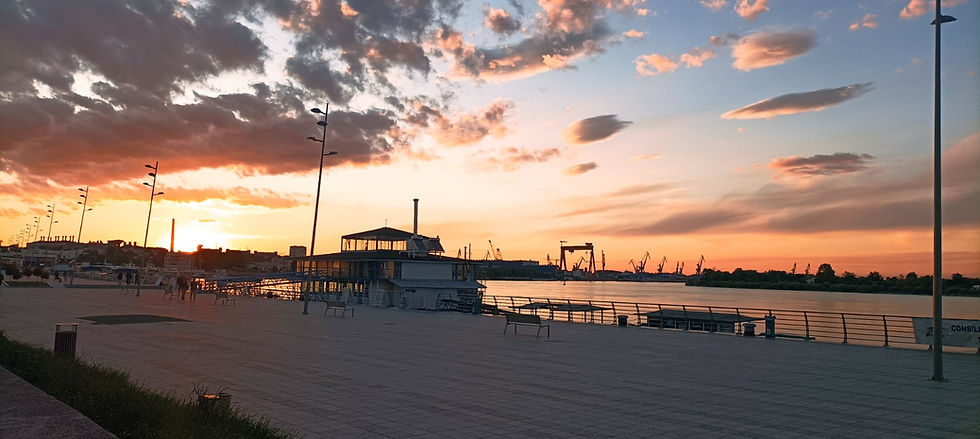
It seemed that by coming to the delta I’d finally finished a trip that I’d started a long time before. Most visitors to the mouth of the Danube and Sulina – a once important trading town, now with new cafes along the quays whilst grand 19th century municipal and business buildings fall to neglect - stay a few hours to look around before taking the next water bus back to the dry land world. I stayed for three days, finding it hard to leave. I spent most of the time looking out on the waters of the Danube rolling past and out to sea. A raindrop falling in the Black Forest two thousand miles to the west, nearly a whole continent’s width away, could have travelled the length of the river as part of its highway of water. Just as I had. Twice.
Jasper is a writer, photographer and broadcaster, based in West Cork, Ireland with a particular interest in slow travel and adventure, traditional horsemanship world wide, and rural cultures. He is the author of 'Paddle: A Long Way Around Ireland' and 'Water Ways: A thousand miles along Britain's canals'. Instagram @theslowadventure