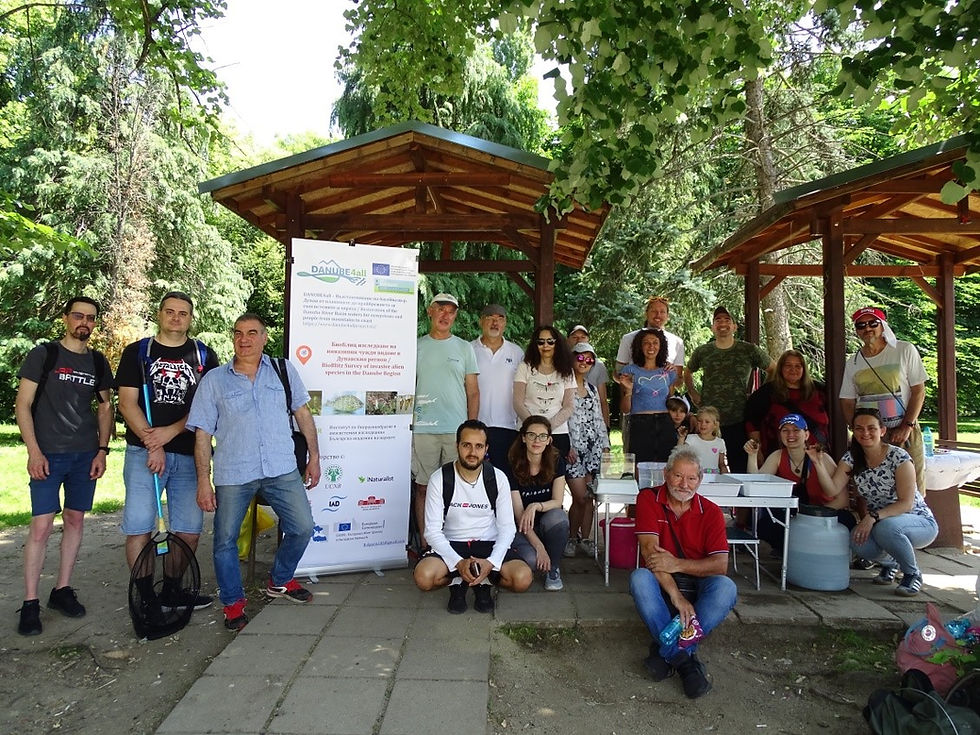
The 45th IAD Conference, Sofia, Bulgaria: Innovative solutions and cooperation to protect and restore biodiversity and ecosystems in the Danube River Basin
Updated: Sep 2, 2025

Contributions from Teodora Trichkova, Marija Smederevac Lalic & Gabriela Costea
In April 2025, DANUBE4all participated in the 45th IAD Conference ‘Innovative solutions and cooperation to protect and restore biodiversity and ecosystems in the Danube River Basin’, which was held on 9–12th April 2025 in Sofia, Bulgaria. The IAD (International Association for Danube Research) conference was organised by DANUBE4all project partner Institute of Biodiversity and Ecosystem Research, Bulgarian Academy of Sciences (BAS), the Climate, Atmosphere and Water Research Institute, (BAS), the General Secretariat of IAD, Danube Region Invasive Alien Species Network (DIAS) and Union for Conservation of Nature–Bulgaria (UCNB). One of the aims of this IAD Conference was to showcase the significant achievements made in the Danube and Black Sea Lighthouse by scaling up sustainable solutions related to the main threats to the Danube River Basin as hydromorphological alterations, water pollution, ecosystem degradation, invasive alien species and effects of climate change. The conference objectives were covered by, but not limited, to 12 scientific topics (see more here).
The Conference was attended by 120 participants from 15 countries (Figure 1). Most participants came from Bulgaria, followed by Romania, Serbia, Ukraine, Austria, Hungary, Germany, Czech Republic, North Macedonia, and individual participants from Croatia, France, Ireland, Slovakia, Slovenia, and Türkiye. About 35 of them were young scientists, PhD students and undergraduate students. A total of 83 communications, including 9 keynote, 39 oral presentations and 35 posters were presented within 11 oral and 2 poster sessions that allowed insights into the rich and diverse research on the Danube River Basin and the Danube and Black Sea Region.
Dedicated Session to DANUBE4all
The DANUBE4all dedicated session was chaired by colleague Gabriela Costa (IGB-Berlin) (Figure 1) and two keynote presentations by Gabriella Costa and Teodora Trichkova. The session included presentations concerning ongoing research across the DANUBE4all project:
Ecological status and biodiversity deficit analysis of the Danube River course. Marija Smederevac-Lalić, Martin Tschikof, Paul Meulenbroek, Yusdiel Torres- Cambas, Sonja Jähnig, Teodora Trichkova, Anthony Basooma, Thomas Hein.
Use of multifunctional nature-based solutions (NbS) for river and floodplain restoration. Martin Pusch, Lisa Waldenberger, Abdul Waheed, Marlene Haimann, Ellis Penning, Helmut Habersack
Enhancing ecosystem connectivity and community resilience in the Danube Delta: The Romanian case study of the DANUBE4all and EcoDaLLi projects. Albert Scrieciu, Adrian Stănică, Camelia Ionescu, Christian Ferrarin
Local vulnerabilities and pro-nature activism in ACCTING.eu and contrasting experimental patterns of citizen engagement in DANUBE4all. Martin Felix Gajdusek, Camille Janssen

The DANUBE4all session was chaired by Marija Smederevac-Lalić (IMSI) presented the project with its aims, work packages and main output – development of the Danube River Basin (DRB) Restoration Action Plan. Further, she gave detailed information about WP3: Improve water (ecological) status and key species populations, in particular, its objectives, target species, occurrence data collection, maps of habitat suitability, and gap analysis (Figure 2). You can download Marija's presentation "Ecological status and biodiversity deficit analysis of the Danube River course" here:

Martin Pusch talked about Use of multifunctional nature-based solutions (NbS) for river and floodplain restoration, highlighting the need for a multi-sectoral management approach. He emphasised that the developed Manual on NbS under WP4 will provide the methodological basis for the DRB Restoration Action Plan (Figure 3).

Martin Felix Gajdusek (Zentrum für Soziale Innovation (ZSI) presented DANUBE4all Citizen Science/ Participatory engagement patterns and WP5 activities, including river walks, river clean-ups, exhibition, serious games, participatory theatre, and others (Figure 4).

Albert Scrieciu of Geoecomar, the National Institute for Research and Development on Marines Geology and Geo-ecology in Romania, presented the DANUBE4all Romanian Case Study on enhancing ecosystem connectivity and community resilience in the Danube Delta related to WP7.
Keynote Speakers:

The keynote speech presented by Gabriela Costea focused on Fostering emotional connection and learning the role of education in the Danube River Basin restoration. This keynote included results on bridging the gap between scientific knowledge and environmental action through innovative educational approaches. The presentation highlighted how environmental education becomes transformative when it fosters emotional connections with nature, combining scientific understanding with hands-on experiences and community engagement. It was emphasized the crucial importance of interdisciplinary approaches in Danube restoration efforts and showcased successful case studies, including our current work in the Danube4all and Restore4Life EU Horizon initiatives. These projects integrate creative and innovative methods to inspire meaningful stakeholder involvement and create lasting connections between communities and the Danube ecosystem. For example in Danube4all we developed a co-creation approach engage and to collect citizens’ suggestions for conceptualizing a traveling exhibition on the Danube River, focusing on environmental education about river and floodplain management. We developed an Interactive Collaborative Danube4all Puzzle Wall acting as an intuitive and integrative platform for interactions. By implementing this at 10 sites along the Danube, we collected 527 responses from over 300 participants.

Gabriela also presented and disseminated the children’s book Lau Laughs Again – A Story from the Danube. The story follows a river mermaid’s journey from source to delta, introducing young readers to biodiversity, ecosystem functions, and restoration (Figures 5 and 6). Gabriela is also an IAD Expert Group Leader of the Danube River Education Group. (Read more here).
During the second keynote speech, Teodora Trichkova presented a on Invasive alien species and climate change as major threats to biodiversity in the Danube River Basin and Western Black Sea Coast: Management and restoration and the role of citizen science, including results of DANUBE4all WPs 3 and 5 (Figure 7).

During the Conference excursion participants visited sites along the Upper Iskar River (tributary of the Danube River) and Rila Mountains, where case studies related to river connectivity and restoration activities were presented (Figure 9).

The conference programme is available here: