


Associated Regions micro-projects underway
Updated: Dec 18, 2025

In Year 2 of the project, DANUBE4all awarded grants of €100,000 to 5 regional, watershed revitalization projects. These local watershed restoration projects, called Associated Regions, benefit from and spread the learning, knowledge and expertise generated through DANUBE4all to benefit water systems around Europe.
The projects are categorised under the following themes:
Water Quality Monitoring
DANUBE4all supports the Associated Region Vajgar - Nežárka - Hamerský potok system within the upper Elbe Basin in Czechia on the use of Earth Observation (EO) for real time information on eutrophication and to evaluate state of the lake at current situation. This tool can eventually help monitor other lakes (many smaller ponds upstream).
Biodiversity Monitoring
DANUBE4all supports the Associated Region “Tagus estuary, Portugal” on exploring the potential use of the Delphi Technique questionnaire with the aim to find consensus on issues related to fish (state, pressures, monitoring, conservation, restoration), maps of habitat suitability and on Citizen science tools for monitoring invasive alien species (BioBlitz survey).
Sediment management
The Associated Region project 'Biosphere Reserve Prutul de Jos' in Cahul, Moldova, focuses on planning studies and the evaluation of associated measurements around issues of sedimentation, lake management, water quality, tourism.
Citizen science
The integration of citizen science into activities is a strand of two projects, one in the Tagus Basin focusing on the Municipality of Seixal and the second, in the Kujawsko-Pomorskie region in Poland. Activities that support local river stewardship, water quality improvement, biodiversity monitoring and stronger community connections to rivers and freshwater landscapes will be explored to see how local community commitment can strengthen restoration efforts.
Progress in 2025...
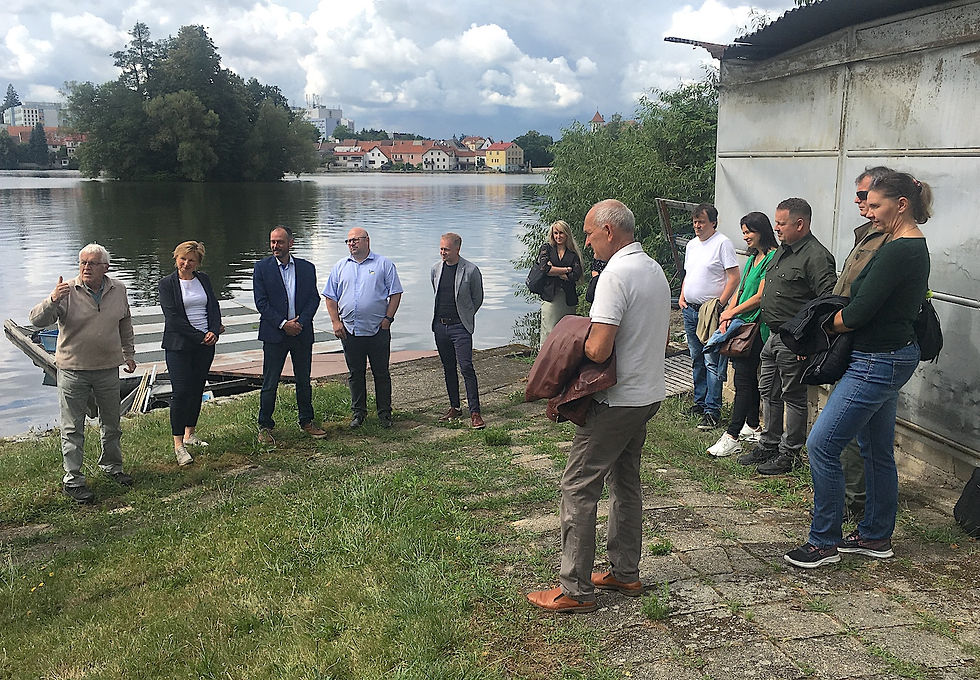
Project: Revitalization of the Vajgar Pond
Location: Jindřichův Hradec, Czech Republic
The Jindřichův Hradec region has been working continuously throughout the year on the monitoring of the Vajgar Pond as part of the pond's overall revitalization strategy.
Progress in 2025:
July - an ichthyological survey on the pond was conducted. This involves a systematic study of the localised fish species, their distribution, and indicators for water quality, pollution levels and overall habitat health.
October - the second stakeholder meeting with key local actors and the general public was held, which provided a forum for presentation and discussion around a year's continuous analyses of the pond and the results of ichthyological research.
A presentation of the project's activities was also given at the online training event as part of the EU Aquaculture Assistance Mechanism programme, also in October.
Two experts from the project also attended the 3rd DANUBE4All annual meeting in Ulm in May this year.
Location: Kujawsko-Pomorskie Region, Poland
Progress in 2025:
Diagnosis of Conditions for Counteracting Agricultural Drought (September 2024 – March 2025)
Expert Workshop – Seminar on Biologization in Agriculture (23 May 2025)
Stakeholders’ Workshop on Citizen Science (30 September 2025)
Engagement in DANUBE4all activities:
Participation in the Associated Regions’ meeting in Ulm (May 2025)
Participation in the DANUBE4all Matchmaking Workshop (February 2025)

Key lessons learned this year:
Collaboration between scientists and local stakeholders is essential for effective drought mitigation.
International knowledge exchange (e.g., Ulm, DANUBE4all) significantly strengthens the quality of solutions.
Early and active stakeholder and citizen engagement improves the effectiveness of citizen science activities.
Clear communication and well-designed engagement methods are crucial for success.
Stakeholder input is vital for shaping future drought management policy.
What's next for 2026?
Information and promotion of citizen science
Involving stakeholders in the citizen science actions, designing actions with the use of citizen science methods
Input to the drought management policy
Location: Seixal Municipality, Portgual
Members of the local community in get involved in the second educational workshop in September. Photos courtesy of Maria João Correia and João Paulo Medeiro.
Progress in 2025:
Our group had a series of online meetings with the WPs leads in order to discuss potential works to be developed in direct collaboration with WPs.
In addition, Ana C. Brito participated in the 3rd General Assembly as a representative of the Tagus Associated Region. The main goal of Ana’s participation was to prepare the 2nd workshop in Portugal, so she had the opportunity to participate in thematic working groups, in order to discuss methods, tools and approaches that could be used and implemented for the 2nd local workshop, which took place in September 25. A summary report can also be downloaded below.
Engagement in DANUBE4all activities:
Our team participated in several discussions within DANUBE4all Working Groups, more specifically in those involved in WP3 (Ecological Quality) and WP5 (Citizen and Community Engagement).
Key lessons learned this year:
Following the discussions and workshops in the first half of 2025, our team was able to propose a set of interesting activities that were discussed and very well received in the 2nd local workshop.
After consulting with local stakeholders, our team is now implementing a meaningful program to engage local communities. The summary report of 2nd workshop (held in September 2025) is attached.
What's next for 2026?
During the next couple of months, we are going to be very involved in the organization of several activities:
i) River cruises – an immersive cruise in the Tagus Estuary focused on biodiversity and ecosystem health and value, ecosystem change and damage,as well as on the impacts on public health;
ii) “MARE à beira-rio” – a set of hands-on activities to catch the interest of a wider public, such as board games, peddy papers, speed dating, use of iNaturalist app to contribute for citizen science; and
iii) Educational project - Training the Teachers. This will involve specific training courses for middle to high school teachers, with in-person time with scientific experts who will promote the development of hands-on projects that can be implemented by teachers in their own classroom environments.
